
India is adopting a two-pronged strategy for artificial intelligence development, focusing on open-source models and indigenous innovation to counter global access restrictions on advanced AI technologies. The government aims to support local developers and ensure AI creates tangible economic impact across various sectors, rather than being solely driven by market speculation.

'Banking is the only sector that can see double-digit growth in FY27.'

Foreign Portfolio Investors (FPIs) have withdrawn over Rs 62,853 crore from Indian equities in the first fortnight of June, bringing the total outflows for 2026 to Rs 2.87 lakh crore, surpassing the entire 2025 figure, driven by geopolitical tensions, global economic growth concerns, and a weakening rupee.

Amidst a sharp run-up in gold and silver prices, investors are advised to rebalance their portfolios by booking partial profits in precious metals and reallocating to domestic equities and debt, according to financial experts.

Companies in the fast-moving consumer goods (FMCG) sector are losing favour with equity investors, with their price-to-earnings (P/E) ratio declining to its lowest level in six years, now trading at 38.8 times trailing earnings.

'We are targeting a 2.5x to 3x increase in valuation by FY31.'

'You set up your SIPs and you do not touch them. Not during COVID, not during a war scare, not when your neighbour tells you the market is finished. You let the noise pass over you.' 'The beauty of this approach is that it does not require courage or conviction in the moment. It just requires inertia -- keep the SIP running and do not look at your portfolio too often.'

India's top 16 IT services companies distributed a record 1.3 trillion to shareholders in FY26 through dividends and share buybacks, a 36.3 per cent increase from FY25, even as the industry grappled with AI-driven business model threats and a significant decline in market capitalisation.

The Reserve Bank of India (RBI) reported a significant 52 per cent year-on-year increase in gains from foreign exchange transactions, reaching 1.69 trillion in FY26. This surge occurred despite the central bank selling a gross $195 billion in the spot market to manage rupee volatility, which saw a 9.85 per cent depreciation.
Infosys Q4 results beat estimates, but weak FY27 guidance triggers cautious brokerage outlook and target price cuts. Should investors worry?

Despite geopolitical tensions and FII outflows, Indian small and midcap stocks have not only recovered losses but are also outperforming largecap indices, driven by attractive valuations, domestic institutional support, and a rebound in earnings.

Fintech platform CRED announced a significant funding round of Rs 8,550 crore led by Meta, coinciding with founder Kunal Shah's departure as CEO to take on the global leadership role for WhatsApp.

'Over the next 12 months, it will be difficult to make 15 to 20 per cent return in the markets as the valuations appear stretched.'

JPMorgan has downgraded Indian equities to 'neutral' from 'overweight', citing elevated valuations, rising earnings risks, and limited exposure to next-generation technology like AI. The brokerage believes other emerging markets offer more attractive risk/reward propositions despite India's strong structural growth story.

The EoI comes at a time when ISRO is working to enhance LVM3's payload capacity to five tonnes in GTO and is also evaluating the procurement of a Russian semi-cryogenic engine for the vehicle's second stage.
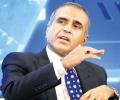
Telecom czar Sunil Bharti Mittal plans to hand over the reins of Bharti Airtel to his children in the next decade and desires that promoter firm Bharti Telecom regains over 50 per cent stake in the company.

The Reserve Bank of India's Financial Stability Report indicates that the interim peace deal between the US and Iran has favourably shifted the balance of risks, reducing headwinds from the West Asia conflict. However, it cautions that exchange rate volatility could increase if crude oil prices spike due to delayed normalisation of supply chain disruptions.

Indian markets on Dalal Street rallied sharply as easing tensions in the US-Iran conflict and stable oil prices boosted sentiment. Track Nifty 50 and BSE Sensex performance and key global triggers.

'Markets never fully lose hope. But an important shift could come if the Strait remains closed -- moving from high prices to no prices.'

rediffGURU Vishal Bisht, founder and CEO of IT services provider Marksman Technologies, recommends strategies to build a successful brand.

Foreign portfolio investors withdrew over Rs 22,530 crore ($2.5 billion) from Indian equities so far this month amid rising US bond yields and a stronger dollar, continuing their selling streak from last year. This came following an outflow of Rs 1.66 lakh crore ($18.9 billion) recorded in 2025, triggered by volatile currency movements, global trade tensions and concerns over potential US tariffs and stretched market valuations.

Macroeconomic data, global geopolitical developments and rising concerns over AI-related disruptions are likely to dictate sentiment in the stock market next week, even as investors may remain cautious amid ongoing volatility, according to analysts.

Despite the Reserve Bank of India's (RBI) and the government's recent initiatives to attract foreign capital, which are expected to alleviate pressure on long-duration bonds, most debt fund managers are maintaining a cautious stance, favouring shorter-duration papers due to global uncertainties and potential future rate hikes.

'It shows that access to these technologies cannot be taken for granted.'

'The bigger unknown remains global geopolitics, which is inherently unpredictable, including developments in our neighbourhood.' 'Another concern is the increasing tilt of government finances towards welfare subsidies, especially at the state level.' 'This could constrain capital expenditure, which is critical for long-term growth.'

With momentum building around the IPO, the NSE saw a surge in retail investors in the last two years, making it one of the widely traded stocks in the unlisted market.

India's first trillion-dollar company will be built on technology it owns, not just operates, predicts Ajay Kumar.

India's electric vehicle market is experiencing an unprecedented boom with a 37 per cent increase in new entrants, driven by supportive policies and infrastructure.

'He's not going to have a lot of long road ahead of him where he's going to play without pressure. It will eventually catch up.'

'With this deal, we may see even 50 launches a year within the next few years.'

Global risks include a potential delay in the US-India trade agreement, the possibility of a sharp correction in US equity markets, and renewed geopolitical tensions.

Foreign portfolio investors have started 2026 on a cautious note, extending their selling streak from last year by withdrawing Rs 7,608 crore ($846 million) from Indian equities in the first two trading sessions of January. The withdrawal of funds followed the largest outflow of Rs 1.66 lakh crore ($18.9 billion) recorded in 2025, triggered by volatile currency movements, global trade tensions and concerns over potential US tariffs, and stretched market valuations.

Indian companies are increasingly opting for demergers, with 29 deals valued at over $40 billion in 2025 alone, marking a 10-year high, as promoters and boards recognise that markets favour focused businesses over complex conglomerates.

Indian equity markets experienced a volatile trading day, with the Sensex and Nifty closing almost flat. Market sentiment was influenced by global cues, US-Iran talks, and profit-booking activities.

'Given that India underperformed emerging markets by 28 per cent in 2025, the worst performance in over 30 years, the timing of the sharp STT hike could have been better.'

Benchmark Sensex tumbled 1,236 points or 1.5 per cent while Nifty closed near 25,450 on Thursday following an across-the-board sell-off amid escalating geopolitical tensions between the US and Iran.

There are vexing questions around the disconnect between Nifty returns and portfolio returns, between economic growth and earnings growth, and finally, between earnings growth and market returns, points out Debashis Basu.

'Portfolios built in these phases often deliver the strongest outcomes over time.'
'Portfolios built in these phases often deliver the strongest outcomes over time.'
